
What are work packages and why do we need them?
Work packages (WPs) appear in grant applications everywhere—even though very few funders explicitly require them. Despite that prevalence, it is surprisingly difficult to find clear guidance on what they are, why they matter, and what separates strong work packages from ones that do not hold together.
Structuring a project into work packages is not about neatly slicing the project into parts. It is about making visible the deeper logic that holds the project together. It is where you show that the project is not only ambitious but doable in the way you claim: that every research question has a method, and every method leads to insight. If anything floats, sinks, or repeats, that is a sign to revise—not to simplify, but to clarify.
In more formal terms, work packages ensure epistemic coherence. Put plainly, they make sure your methods, questions, and outputs logically align and reinforce each other.
How to create work packages from scratch
- Clarify your overarching research aim. Write down your central research question or goal clearly. Work packages only make sense when you know precisely what the whole project is intended to achieve. Keep this visible and refer back to it as you build the WPs.
- Break your project down into smaller questions. Ask: what smaller questions or steps must you answer or take in order to address the main aim? Do not choose research questions simply because you already like them or have been thinking about them for a while. Step back and ask: if I had to build this project from scratch, what would be the logical questions that follow from my overarching aim? The best proposals are structured around what the project needs to ask, not just what you want to ask.
- Identify the method(s) required for each question. For each smaller question, specify the methods or approaches needed to answer it. Check that these methods match the questions logically—avoid overly ambitious or vague combinations.
- Define your outputs clearly. For each work package, decide what the specific outcomes will be: articles, datasets, presentations, policy briefs. Clearly linking outputs to questions and methods helps ensure your WPs are coherent and feasible.
Use work packages as an internal stress test
Once you have a draft WP structure, the real work begins. If there are inconsistencies, you face a choice: do you change the research questions to fit the overall aim, or are the RQs genuinely the most important ones, so that the project aim needs to change? Similarly, if you are set on a novel methodology but it does not follow logically from the RQ, do you change the RQ (with repercussions further up into the aim)? Here is how to do that in practice.
- Check for floating questions. Review each WP to ensure every research question is genuinely answerable with your proposed methods. If a question seems disconnected from your methodology, reconsider its formulation, method, or its place in the project. If a question floats freely, anchor it explicitly or remove it.
- Perform a redundancy audit. Map tasks and methods clearly across your WPs to spot overlaps, repetitions, or gaps. Look for tasks that appear more than once without adding clear value. Redundancy signals unclear thinking—clarify how each WP contributes distinctively.
- Reflect on what is missing. Step back and ask whether all your WPs collectively build towards answering your overarching research question. Consider if there are crucial sub-questions or complementary methodologies that would strengthen the project but are currently absent. Using your WP structure to notice what is not there can highlight important gaps and opportunities for refinement.
What a strong work package structure looks like
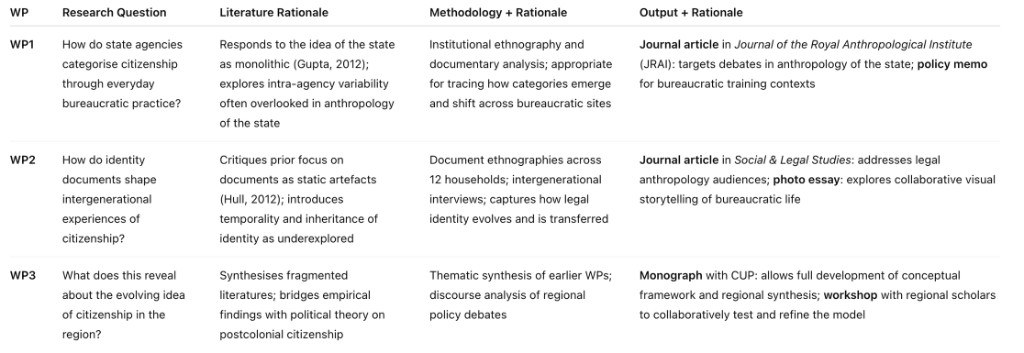
A solid work package structure is one where every choice earns its place. The logic is tight: research questions, methods, and outputs are clearly aligned and mutually reinforcing. It does not just list deliverables—it shows a deliberate dissemination strategy, with each output targeted to a specific audience or purpose. The structure reflects awareness of current field debates, publishing norms, and the expectations of different reader communities. By including a variety of knowledge formats—academic articles, a monograph, policy briefs, a visual output—it demonstrates both intellectual ambition and a commitment to broader engagement.
What to avoid: work package pitfalls
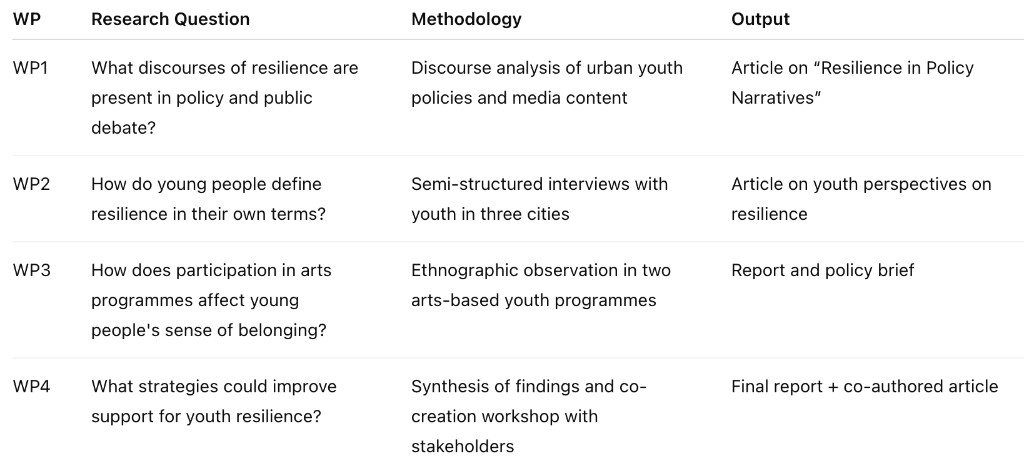
In a weak structure, WP2 might use semi-structured interviews to understand how a group defines a concept, but there is no indication of how those definitions will be analysed (theoretically, thematically, or otherwise). Another WP might use ethnography in only two sites, which may not support broader claims unless carefully justified—methods can seem chosen for feasibility rather than epistemic fit. In a fourth WP, the “final report” is too vague: unclear who it is for, how it will be written, or how it will reach the right audience. Without a clear dissemination plan or target reader, the value of the output is hard to assess. Outputs need both a purpose and a pathway; otherwise they risk being ignored, regardless of quality.
Conclusion
There is no single formula for structuring work packages. What works in one proposal might fall flat in another. The right approach depends on your research design, your discipline, and the expectations of the funder. Some projects need tightly sequenced WPs; others benefit from parallel strands. Some call for detailed deliverables, others for open-ended exploration. Over the years I have reviewed and supported hundreds of applications across a wide range of schemes, and strong proposals can look very different. If you are working on a grant and want a clear, critical perspective on how to strengthen your work packages—or your application more broadly—you can get in touch.